
“Doctor, I’ve been feeling dizzy and experiencing pain lately,” Boss Qiao said.
“Do you usually measure your blood pressure at home?” the doctor asked. “When you just arrived at the clinic, your blood pressure was very high—192/118 mmHg.”
“I usually don’t feel unwell, so why would I measure my blood pressure?” Boss Qiao asked in confusion.
High Blood Pressure Often Has No Symptoms
First, let’s understand what blood pressure is. Blood pressure represents the force exerted by blood against the walls of the arteries as the heart pumps it around the body. Blood pressure readings typically have two numbers, such as 127/83 mmHg. The first number represents the “systolic pressure,” and the second number is the “diastolic pressure.”
“Systolic pressure” refers to the pressure in the arteries when the heart beats; “diastolic pressure” refers to the pressure when the heart rests between beats. Since the pressure is higher during heartbeats, systolic pressure is higher than diastolic pressure. In a reading of 127/83 mmHg, the systolic pressure is 127 mmHg, and the diastolic pressure is 83 mmHg.
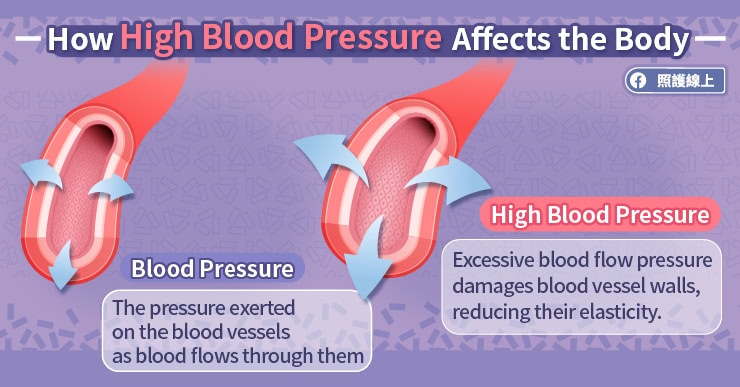
Healthy adults generally have a blood pressure below 120/80 mmHg. Regularly measuring your blood pressure is important because high blood pressure often does not have noticeable symptoms. However, long-term high blood pressure can cause significant health issues because it means the blood is exerting excessive force on the artery walls, causing damage over time. The longer high blood pressure persists, whether unnoticed or ignored, the more dangerous it becomes, leading to more complications.
Now, let’s look at the health risks associated with high blood pressure.
◆ Insufficient Blood Flow and Ischemia
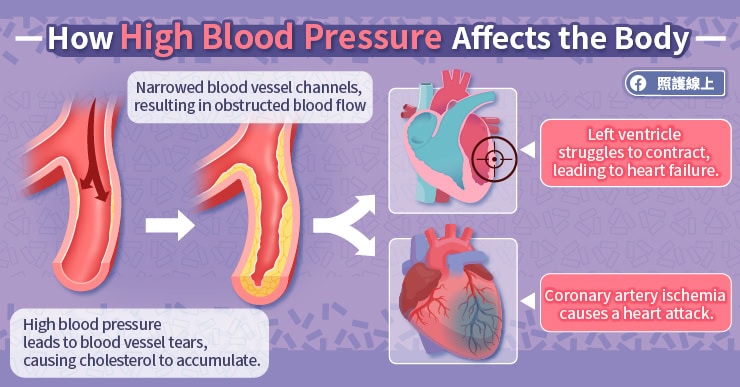
Our blood vessels should be strong and flexible. However, when blood pressure is high, the continuous pressure can cause tiny tears in the artery walls. These tears can lead to cholesterol buildup, narrowing the vessels and impeding blood flow.
The more blockages in the blood vessels, the harder it is for blood to reach tissues or organs. If this occurs in the coronary arteries supplying the heart, it can lead to angina or arrhythmias, commonly known as “myocardial infarction,” where the coronary arteries are blocked, and blood flow to the heart muscle is compromised, impairing its function.
High blood pressure can damage blood vessels throughout the body, not just those in the heart. For example, blockages in the blood vessels supplying the sexual organs can lead to sexual dysfunction.
(Extended Reading: Myocardial Infarction – Critical Care! Clearing Blockages and Preventing Recurrence Explained by a Cardiologist)
◆ Heart Failure
High blood pressure causes tiny tears in the arterial walls, leading to cholesterol buildup and narrowing of the vessels, which obstructs blood flow. When blood flow is restricted, the heart has to work harder to pump blood to various organs and tissues, but its efficiency remains poor. The left ventricle works harder to push blood out, and over time, this can lead to heart failure. Patients may experience shortness of breath, fatigue, and edema.
(Extended Reading: Heart Failure – Common Issues and 8 Myths Debunked!)
◆ Aneurysm
Persistent high blood pressure weakens the artery walls, which can lead to the formation of an aneurysm, resembling a balloon that’s been inflated. Such an aneurysm is inherently weak and can grow larger due to continuous high pressure, eventually rupturing and causing life-threatening internal bleeding.
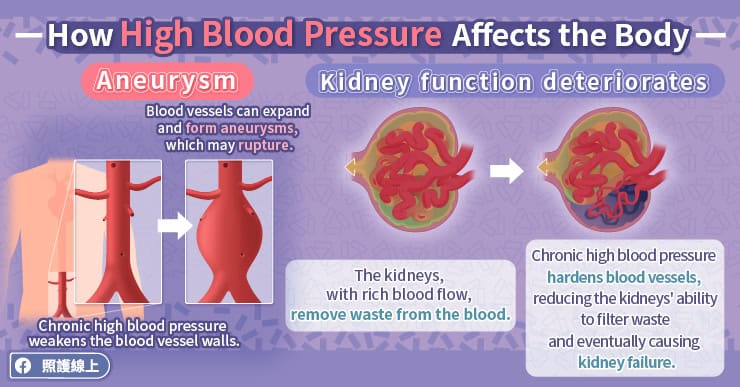
Aneurysms can occur in various parts of the body. For example, a brain aneurysm can cause severe headaches and loss of consciousness if it bursts, while an abdominal aortic aneurysm may present as a pulsating lump and can cause intense abdominal pain and potentially be fatal if it ruptures.
(Extended Reading: Explosive Headaches and Stiff Neck – Beware of Brain Aneurysm Ruptures! Explained by a Neurosurgeon)
(Extended Reading: Addressing Difficult Abdominal Aortic Aneurysms – The Importance of Endovascular Stent Grafting Explained by a Cardiovascular Surgeon)
◆ Decline in Kidney Function
High blood pressure can damage areas with dense blood vessels, such as the kidneys. The kidneys are responsible for removing waste from the blood, regulating blood volume and pressure, and producing urine. They contain many small blood vessels that filter waste. High blood pressure causes these vessels to harden and become damaged, reducing their ability to filter waste efficiently, which can lead to kidney failure.
◆ Cognitive Impairment, Dementia, and Stroke
Over time, high blood pressure damages blood vessels, reducing blood flow to the brain. This deprives brain cells of sufficient oxygen and nutrients, causing them to die more rapidly. As a result, concentration decreases, memory worsens, and clear thinking becomes difficult. Cognitive impairment may develop, and in more severe cases, it can lead to vascular dementia. So, remember, taking care of your blood vessels is essential for keeping your brain healthy.
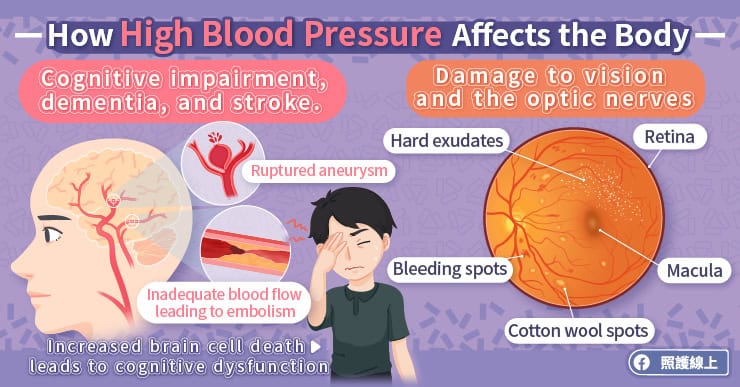
If atherosclerosis becomes severe, blood flow can be directly blocked, leading to the loss of more brain functions—what we commonly refer to as an “ischemic stroke.” If high blood pressure causes a brain aneurysm to rupture, it results in a hemorrhagic stroke. In either case, brain function will decline. Even if the patient survives, they may still face long-term issues such as cognitive impairment and dementia.
(Extended Reading: Four Steps to Reduce the Risk of Dementia)
◆ Damage to Vision and Optic Nerves
The eyes contain many delicate blood vessels. High blood pressure can damage these vessels, causing retinal hemorrhage and blurred vision or even complete loss of sight. It can also affect the blood vessels supplying the optic nerves, further deteriorating vision.
Don’t Wait for Symptoms of High Blood Pressure
High blood pressure often has no symptoms initially, so people might not pay much attention to it. However, it’s important to manage blood pressure effectively to prevent damage to multiple organs and complications. To avoid these issues, focus on diet, exercise, and medication, and regularly monitor your blood pressure to stay informed about your health status.